In Stock
Paintings
SKU: SKU-62
Monochrome Pattachitra – Panchamukhi Ganesha Panel (Unframed Artwork)
Black-and-white Pattachitra on cotton; ready to mount or frame
grade
grade
grade
grade
grade
(0 Reviews)
Ask for Price
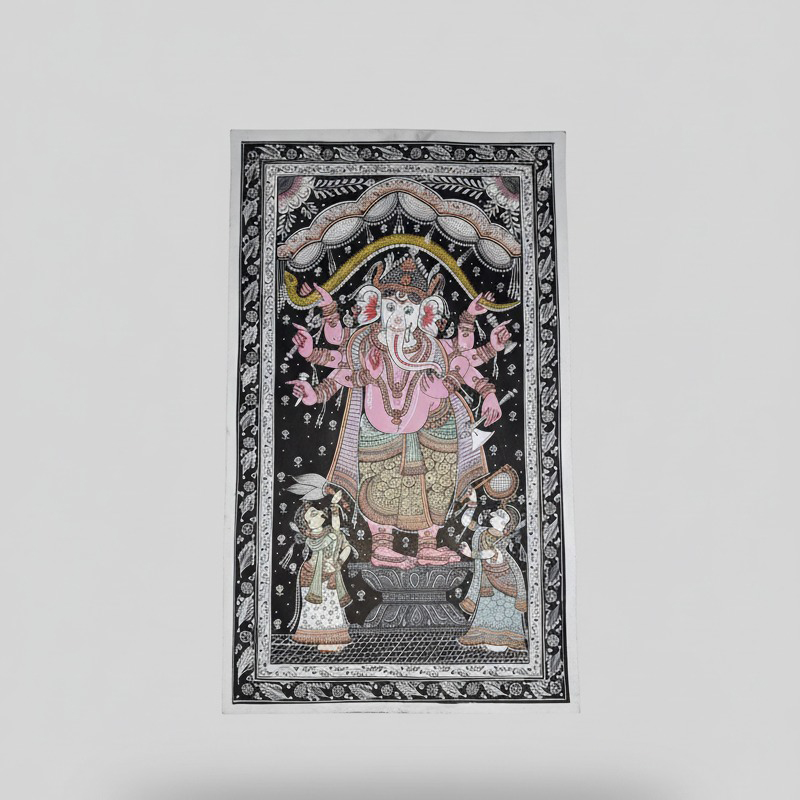
Unframed monochrome Pattachitra panel of five-aspect Ganesha with attendants—lampblack and conch-white on cotton with gentle blush accents; museum-grade handwork ready to mount or frame.
This unframed Pattachitra panel renders Panchamukhi Ganesha with a calm gravity that feels both intimate and cosmic. Without a frame the craft speaks even more clearly: the prepared cotton sheet, its edges softly irregular, carries the trace of the workshop—the sizing gloss, the tooth of the weave, the slight cockle where pigment dried in winter air. The composition is cousin to the framed variant yet distinct in presence. The black ground is pricked with constellations; a cusped arch and braided canopy rise over the deity; two attendants stand in attendance with flywhisks and lotuses, their garments patterned as densely as prayer carpets. The palette holds to lampblack and conch-white, with the lightest blush deployed on body and jewelry to gather warm breath into the monochrome.
A devotee versed in iconography will recognize the mind-training that the attributes propose. The noose and goad, drawn with fine double lines, remind the viewer that discipline is not denial but gentle redirection; the modaka bowl stands for the sweetness that attends concerted effort; the broken tusk, gripped like a stylus, is the emblem of self-reliance in learning. These symbols are not scattered; the artist arranges them to balance diagonals and arcs, so that narrative instruction and visual stability co-operate. The mouse vahana, tiny but sure-footed, keeps company near the plinth, facing the same direction as the devotee—eye-lines that usher the viewer into the sanctum.
Where color recedes, line must carry music. The chitrakara scores the surface with hatching that turns flat robes into woven brocades, with stipple that makes halos pulse, with pearls of white that march across borders like rhythmic syllables—dha dhin dhin dha—until the whole panel becomes a raga in dots and curls. Lotus rosettes, creeper vines, and scalloped bands proliferate, yet nothing feels crowded; intervals of unmarked black act as rests in a composition that knows the value of silence. The canopy’s inner curve mirrors the arch and the round of the halo, generating a nested geometry—circle within arch within rectangle—that quiets the mind like a breath exercise.
Because the work is unframed, collectors have freedom. Float-mount it to honor the hand-cut edge; choose a generous off-white mat to let the border breathe; or pair it with a dark wood frame to echo the monochrome gravitas. For pooja rooms, a simple teak frame with UV-protective acrylic suffices; for living rooms, a thin-profile metal can make the piece feel crisp and contemporary without tension. In all cases, keep it from direct, harsh sunlight and high humidity; dust glazing rather than the surface; and if storing, interleave with acid-free tissue and keep flat.
The panel carries cultural weight beyond décor. Pattachitra is not a relic but a living practice. Families in coastal Odisha still size cloth with tamarind seed paste, grind mineral colors, and pass down brush control through apprenticeship. Buying such a work is to vote for that continuity: for schools where children learn to balance a brush with fingertips, for studios that sing while dotting star-fields at midnight before Rath Yatra, for a village economy where devotion and livelihood coincide. Even if you approach the piece without ritual intent, it gives you a daily discipline: to look, to breathe, to notice one more pattern, to find a new story in the attendants’ tilt or the mouse’s whiskers.
In design terms the panel is a subtle powerhouse. Black-and-white art stabilizes rooms with busy materials—veined stone, patterned rugs, shelves of books—and converses fluently with neutrals. The micro-ornament invites near-viewing, which encourages the very slowness modern rooms often lack. Hang it where you can pause: near a reading chair, above a console where keys pause each evening, or opposite a window that brings soft light. Under low light the white rekha glows like moonlit thread; under morning brightness the blush tones wake up, and the canopy’s vinework becomes a garden.
Every handmade thing bears biography. On this sheet you can find it in a faint pentimento where the trunk’s curve was adjusted, in an extra dot added to balance a vine, in a hairline that thickens for a heartbeat where the artisan reached for more pigment. These are not errors; they are the human tempo of making. Panchamukhi Ganesha, remover of obstacles, begins not by making your path easy but by showing you how attention makes any path walkable. This painting models that attention: steady, exact, joyful in the patience of dots.
| Material | Lampblack, conch-shell white & natural earth pigments on hand-primed cotton (Pattachitra) |
|---|---|
| Color | Monochrome (black/white) with pale blush and metallic-grey detailing |
| Weight | N/A |
| Dimensions | N/A x N/A x N/A |
| Brand | Artisan |
rate_review
No reviews yet. Be the first to share your thoughts!
Write a Review
Please log in to write a review.
Log InYou May Also Like
View All